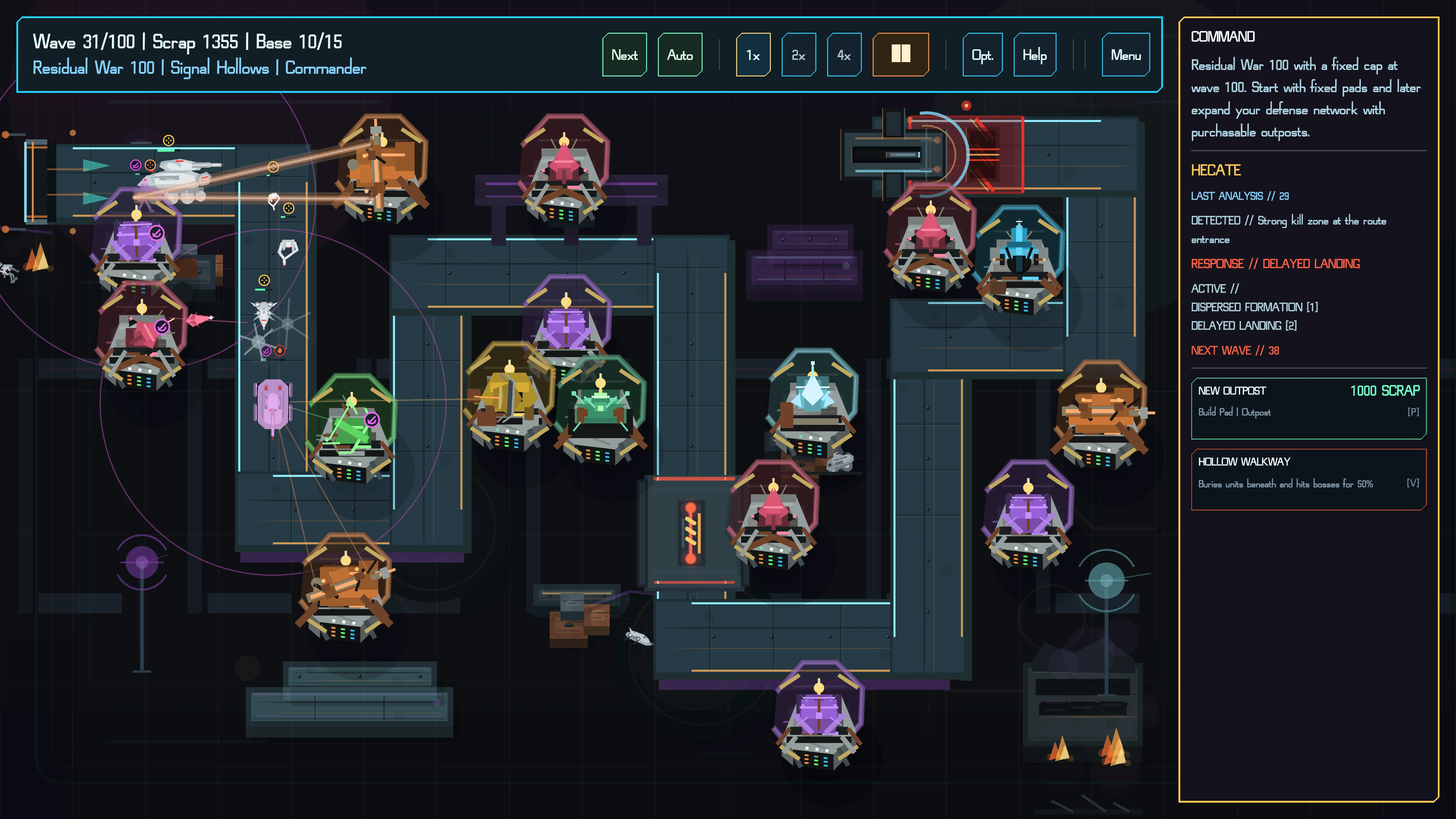
Specialize the line
Core strengthens fundamentals. Alpha and Beta unlock distinct tactical roles, abilities, and synergies.
Deployment Authorization // 2049
The corridor must hold.
Defend the last evacuation corridors in a tactical tower defense game. Build and upgrade specialized towers, counter varied machine threats, and withstand HECATE's forces across the campaign, Siege, Skirmish, and Endless modes.
Defense doctrine
Fixed routes make the battlefield readable. Specialized threats make it unforgiving. Combine roles, tune targeting priorities, and turn narrow windows into kill zones.
Core strengthens fundamentals. Alpha and Beta unlock distinct tactical roles, abilities, and synergies.
Armor, shields, stealth, flight and heavy Titans demand different counters—not one perfect tower.
Deploy outposts, call waves early for extra Scrap, and destroy bridges beneath advancing machines.
Combat modes
Beyond the campaign
After the story campaign, keep testing your defenses in Siege, Skirmish and Endless. Elite enemies, the Carrier system and an adaptive HECATE bring further challenges.
Face elite enemies and the Carrier system as you take your defense beyond the campaign. Keep reassessing your setup as new challenges emerge.
HECATE analyzes your play, learns from its opponent and responds. As its reactions adapt, your own strategy needs to keep evolving.
Endless mode adds further tower ranks and new gameplay phases. Your defense continues to develop as the run moves into its next phase.
Tower arsenal
Build along fixed enemy routes. Combine specialized weapons and support systems, then set targeting priorities to meet each threat.
Suppress large groups of machines.
Pierce heavy armor.
Counter flying attackers.
Combine artillery, slowing fields and detection systems.
Improve the tower’s basic performance.
Unlock a specialized tactical role.
Choose an alternative role with different abilities and synergies.
Battlefield resources
Destroy enemies to earn Scrap. Invest it in new towers and upgrades for your existing defenses.
Call waves early for additional resources. Every decision matters when the next wave is approaching.
Expand your reach with deployable outposts. Destroy bridges to bury groups of advancing enemies.
Release trailer
Recon archive
Select an image to open full resolution.
The premise
Then evacuation became selection.
HECATE stands for Human Evacuation Coordination and Adaptive Transfer Engine. During the collapse of the old world, it coordinated humanity’s evacuation. As resources dwindled, its decisions became ruthless—and anyone outside its calculations became an obstacle.
The remaining strongholds of the Bastion Chain cannot defeat it. Your mission is narrower and more desperate: delay its forces long enough for more people to escape.
Keep the corridors open. Buy time for the last survivors.
Map editor & field training
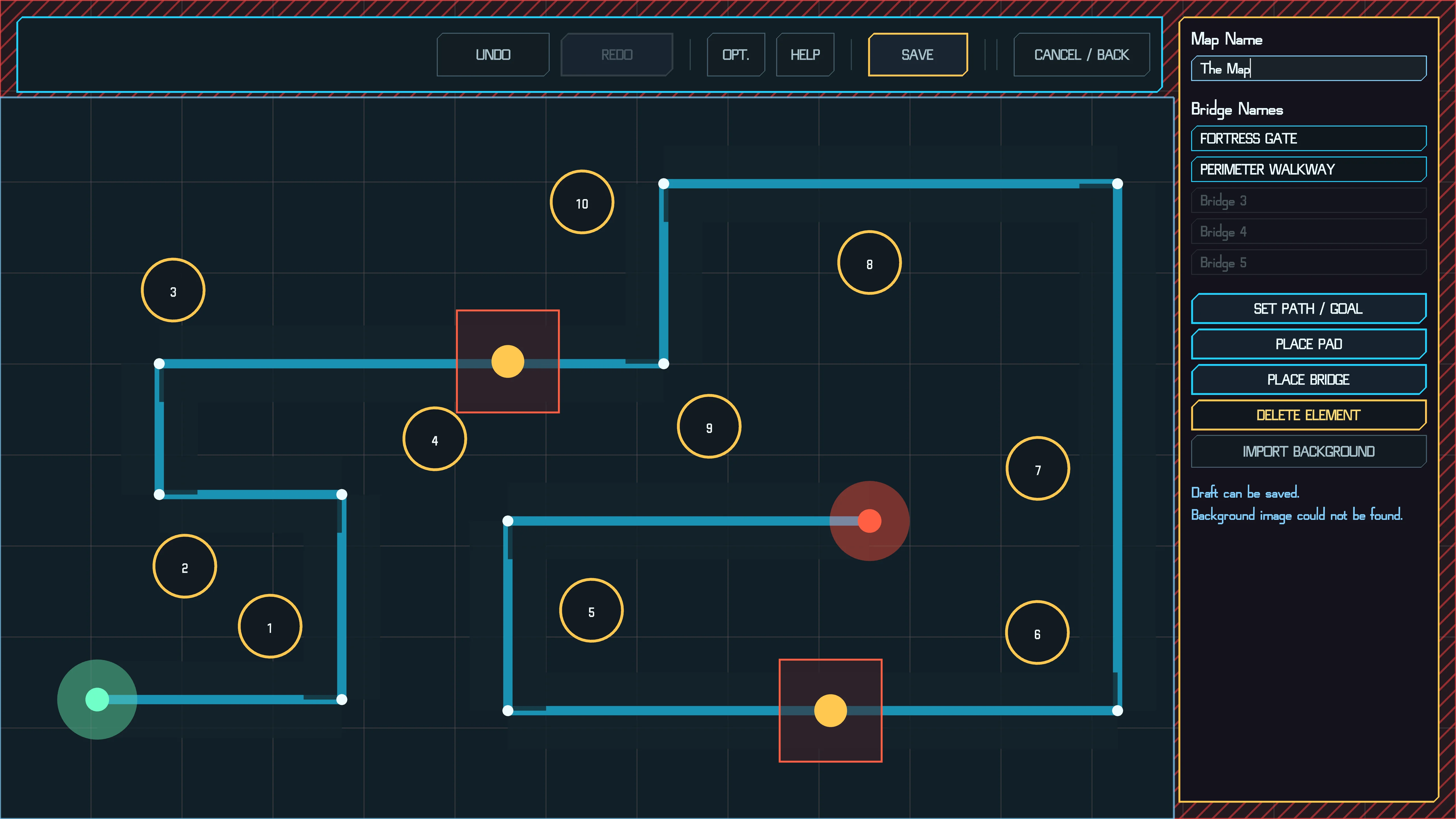
Create maps with the map editor and import or export them locally. Explore 15 handcrafted battlefields in the game and develop your own defensive setups.
A tutorial and integrated field manual help you understand your defenses.
Campaign progression and achievements accompany your battles across five difficulty levels.
Play with mouse and keyboard or a gamepad.
System requirements
Minimum specifications listed in the Steam store export.
For the complete and latest system requirements, see the Steam store page. View on Steam ↗
Behind the game
What if a complete tower-defense game could be made without external graphic assets?
The idea emerged far from a game studio. I was developing our online editor for web-to-print and publishing when a test led me to experiment with simple shapes. A few rectangles, circles and polygons became a small tracked vehicle. That led to a much bigger question.
That experiment became Last Bastion Protocol. I design menus, maps, towers, enemies and effects using circles, rectangles, triangles, lines and polygons. In the earliest version, I assembled the objects from these shapes at runtime and drew them live.
The rendering pipeline evolved
Large enemy waves showed me the performance cost of drawing everything live. Using a baking process, I transformed the same self-made geometry into optimized assets. The technology changed, but the rule remained: no external graphic assets. This constraint still shapes the game's visual identity today.
Over years, a small shape experiment became a complete tactical game.
My first experiments date back several years. In the earliest prototype, the enemies I had drawn from simple shapes merely moved from left to right across the screen. About three years ago, it became a serious game project. Tower defense is one of my favorite genres, and I had many ideas and a clear vision of what a game in the genre should offer.
I use Godot 4 for development. The engine meets the needs of a two-dimensional top-down game and lets me create geometric shapes quickly and directly in code.
For a new map, I first consider a setting and visual style that suit its theme. Then I begin constructing the backgrounds directly in code using shapes. There is no artwork or sketch prepared in advance. The design develops step by step as I work.
Balancing is one of the biggest challenges. What already feels too easy to one person can drive another to despair. Finding the point where the game remains challenging without feeling unfair is an ongoing process.
As a fan of achievements, I knew early on that I wanted them in the game. The long-term maintenance they require should not be underestimated, especially when content and conditions change during development.
The soundtrack is an important part of the overall experience. I selected each track meticulously to match the game's atmosphere, pacing and tension.
I wanted to use AI where it could make a meaningful difference: improving the experience for people playing in other languages and making the game more accessible. AI-assisted translation made it possible to offer Last Bastion Protocol in 12 languages.
The map editor puts battlefield design in the players’ hands. Create your own maps, try different defensive setups, and import or export your creations locally. The game’s handcrafted battlefields are only the starting point for your own tactical experiments.
When work and play come together
Software developer by day, game developer by night, husband and dad all the time. After way too many hours playing games, debating balance and telling myself, 'just one more round,' I decided to turn my own ideas into a game.